The Creative Journey
How this design went from a thought to a shirt. Every step — the idea, the research, the collaboration, the design choices, and what happened after.
Research conducted by Perplexity AI · Design and creative direction by GQuixote
Inception
How the idea came about
The idea started with a simple discomfort. The kind you feel when someone says “my God is the only real God” with absolute certainty — and you know, because you’ve read even a little history, that thousands of people said the same thing about gods no one remembers anymore.
I kept thinking about the gap between how real a god feels to the person praying and how completely that same god can vanish from human memory. Ra was the supreme being for three thousand years. Now he’s a museum exhibit. Marduk had a temple that dwarfed anything in Jerusalem. Now children learn his name only in university lecture halls, if at all.
The question wasn’t “does God exist?” That’s a different conversation. The question was: how many gods have humans been absolutely certain about, and where did all that certainty go?
This became the first design in the God and Religion subsection because it sets the frame for everything that follows. Before you can talk about religious ignorance, dogma, or the cost of certainty, you have to establish the scale of the picture.
Research
The research behind the design
I asked Perplexity AI to find out how many gods humans have actually worshipped. The research returned several converging estimates:
Anthropological estimate: At least 18,000 different gods, goddesses, and various animals or objects have been worshipped by humans since our species first appeared, according to anthropological estimates cited by Psychology Today. Other sources narrow this to 8,000–12,000 for recorded history specifically.
Mesopotamia alone: The names of over 3,000 Mesopotamian deities have been recovered from cuneiform texts. The longest single list — a Babylonian scholarly work called An = Anum — catalogues over 2,000 deities, complete with their relationships, functions, and short explanations.
Ancient Egypt: Over 2,000 deities in the Egyptian pantheon. Gods for every river, every crop, every hour of the night, every stage of the afterlife.
Shinto: The phrase yaoyorozu no kami (八百万の神) translates as “eight million gods” — not a literal count but a poetic way of saying the divine is everywhere and uncountable. Every river, mountain, tree, and village has its kami.
Hinduism: Popularly described as having 330 million gods (33 koti devas). However, the word koti can mean both “crore” (ten million) and “type” or “category,” making the figure contested. In practice, there are roughly 40–50 major Hindu deities with around 300 alternative names, though local and folk traditions add thousands more.
The forgotten: Many deities survive only as names on stone fragments. In Palmyra, over 2,500 Aramaic inscriptions reference what scholars called the “Anonymous God” — until researcher Aleksandra Kubiak-Schneider showed these were likely multiple deities addressed by epithet rather than name. In a Spanish cave called Cova Dones, 120 Latin inscriptions reference a goddess called “Domina” (the Lady) and another known only as “MALACI” — a deity we otherwise know nothing about.
The dead religions: At least 20 major religions have completely died out — Hellenism, Roman paganism, Norse paganism, Mithraism, Manichaeism, Canaanite religion, Aztec religion, Mayan religion, Celtic paganism, Etruscan religion, the Elamite faith, and more. Their gods were not abandoned because people stopped believing. They were converted, conquered, or killed.
Full sources are listed in the Sources & References section below.
Collaboration
Human + AI process
This design was a collaborative effort. I brought the concept, the moral pressure, and the creative direction. Perplexity AI brought the research, the data processing, and draft language.
The initial prompt was simple: “How many gods have humans worshipped throughout history?” The AI returned the anthropological estimates, the Mesopotamian god lists, the Shinto concept, the Hindu koti ambiguity, and the stories of forgotten deities. I had not heard of the An = Anum tablet before. I had not known about the “Anonymous God” of Palmyra or the goddess Domina in Cova Dones. These came from the research.
What I brought was the framing. The AI could tell me that 18,000 gods had been worshipped. It could not tell me why that number should make someone uncomfortable — that the same certainty that built temples to Ra and Marduk is the certainty that builds churches and mosques today. That connection is the human input. The discomfort is mine.
The back-of-shirt text went through several revisions. The AI suggested versions that were more academic. I stripped them back to something shorter, harder, and more honest. “Certainty is not proof” is the line I kept coming back to — it’s the one I wanted a stranger to read on a bus and carry home with them.
The final design is solely owned by GQuixote. See the copyright notice below.
Design Process
Typography, layout, and iteration
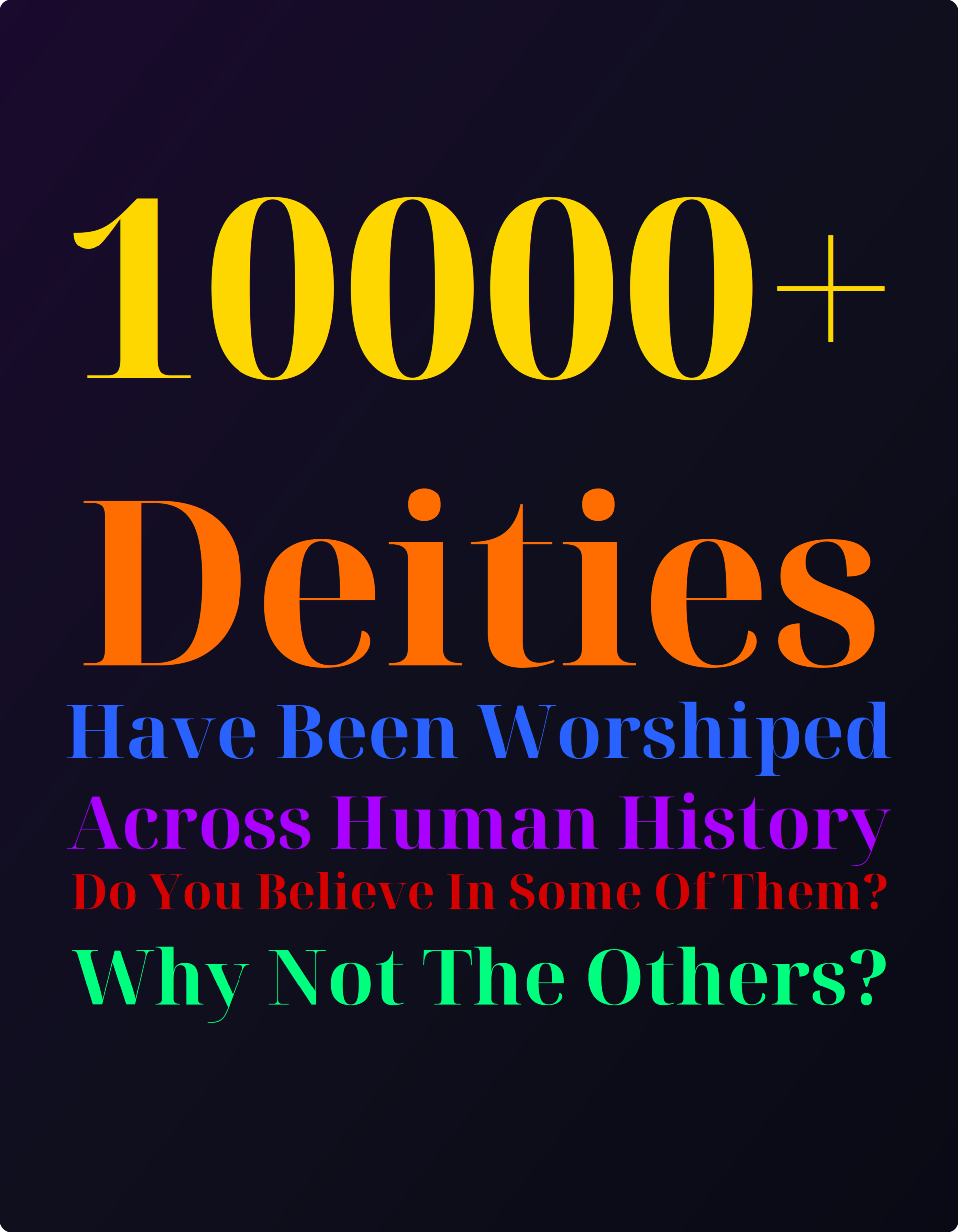
The front needed to be stark. No illustration, no decoration, no visual distraction. Just the number and the word. “10,000” hits first — large, heavy, unavoidable. “DEITIES” lands second, smaller but still bold. The reader processes the number before they process what it’s counting.
The back is where the argument lives. Four short blocks: what people did for their gods, the fact that most are now mythology, and the punchline — “Certainty is not proof.” The QR code sits below, small, inviting rather than demanding.
Earlier versions of the back text were longer. One version listed specific dead gods by name — Ra, Marduk, Zeus, Odin, Quetzalcoatl. It read like a lecture. Another version used the word “myth” instead of “mythology” — sharper, but too aggressive. “Mythology” carries the weight of distance. These were gods. Now they are mythology. That gap is the whole point.
Font choice: Cabinet Grotesk in heavy weight for the front — geometric, modern, almost brutalist. The back uses Satoshi at a readable size — clean enough to read at arm’s length on a bus, small enough to require the reader to actually look.
The Message
What this design is saying
The front says: a number. A big number. Big enough that you cannot hold all of it in your head at once.
The back says: every one of those gods was real to someone. People prayed to them. People killed for them. People built temples that outlasted empires. And now those same gods are characters in stories we tell our children about “mythology.”
The final line — “Certainty is not proof” — is not an argument against God. It’s an argument against the kind of certainty that closes questions. The ancient Egyptians were as certain about Ra as any modern believer is about their God. Certainty was not proof then. It is not proof now.
The person wearing this shirt is saying: I am not asking you to stop believing. I am asking you to notice the pattern. Every age is certain. Most ages are wrong.
After Completion
Reflections and reactions
To be updated after the first print and wear test. I want to see if people read the front and react to the number, or if they wait for the back. I want to know if anyone scans the QR code. I want to know if the word “mythology” makes someone flinch.
Check back after the shirt has been worn in public.
Comments